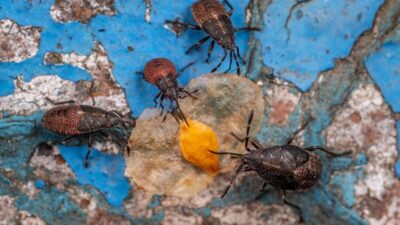
Tiny reddish specks crawling across windowsills or sunny walls can be easy to mistake for insects at first glance.
Clover mites usually become noticeable when large numbers move from lawns and vegetation toward buildings during cooler parts of the year. Learning how to get rid of clover mites helps to separate the indoor nuisance from the outdoor conditions that are driving them toward the house.
1. How to Get Rid of Clover Mites?
Clover mites are extremely small plant-feeding mites, generally measuring less than 1 mm long. Adults are often reddish, brownish, or dark green and have an unusually long first pair of legs.
Remove Clover Mites Inside the House
For how to get rid of clover mites indoors, start with physical removal rather than pesticide spraying.
Indoor insecticide treatment is usually unnecessary because clover mites do not reproduce inside homes and typically die within a few days from dehydration.
If mites repeatedly collect at the same window, double-sided tape can help intercept them before they spread farther into the room.
Control Clover Mites Around the Exterior
Exterior control matters more for recurring invasions. Clover mites live primarily in turfgrass and other vegetation.
Removing grass and host plants directly against the foundation can make it harder for them to reach the building.
Recommended vegetation-free barriers vary by region and source, but guidance ranges from about 6–24 inches to a wider 3–5 foot strip where infestations are persistent.
2. What Environmental Conditions Attract Clover Mites?
Clover mites prefer cool-season conditions rather than peak summer heat.
They are commonly active in spring and fall. Eggs can begin hatching when temperatures rise above about 45°F, and activity increases during mild weather. Their populations are often associated with:
- Lush or heavily fertilized lawns
- Dense grass growing directly against the foundation
- Warm south- or west-facing walls
- Dry turf near buildings
- Mild spring or fall temperatures
>>> Read more: How to Get Rid of Mealybugs and Save Your Indoor Plants
3. How to Seal the Places Clover Mites Use to Get Inside?
Clover mites are small enough to move through tiny cracks and may even pass through ordinary window-screen mesh.
Inspect the exterior carefully before the next migration period. Pay attention to:
- Window frames
- Door frames
- Siding joints
- Foundation cracks
- Utility penetrations
- Gaps beneath trim
- Vents
- Wall joints
Use caulk or appropriate exterior sealant around fixed gaps and replace worn weather stripping around doors and windows.
Sunny sides of the home deserve extra attention. Clover mites frequently climb south- and west-facing surfaces before finding small openings around windows or structural joints.
Because these mites may gather in the hundreds or thousands, sealing before seasonal movement begins is much easier than trying to remove them one by one later.
4. When to Call Pest Control for Clover Mites?
Most clover mite invasions can be handled without professional treatment. Consider pest control when:
- Hundreds or thousands repeatedly enter the home
- Mites return every spring or fall despite sealing
- Exterior walls are difficult or unsafe to access
- Lawn populations remain extremely high
- Several rooms are affected
- You cannot locate the main entry points
Exterior pesticide treatment may sometimes be used around foundations, vegetation, and affected lawn areas, but only products labeled for the exact application site should be used. Incorrect applications can damage plants or stain building surfaces.
5. FAQs
If you’re noticing tiny red specks crawling across your windowsills or lawn, knowing how to get rid of clover mites will help you eliminate them at the source and keep them from coming back.
Do Clover Mites Bite Humans?
No. Clover mites do not bite people, transmit disease, or feed on household furnishings or stored food.
Their main indoor problem is nuisance activity and the red staining that can occur when they are crushed.
What Attracts Clover Mites to a House?
The house itself is usually not their food source. They are attracted to conditions around the property, particularly dense turf, vigorous vegetation, dry sunny areas near foundations, and warm exterior walls.
They then enter cracks while migrating or searching for protected locations.
How Long Do Clover Mites Stay Around?
Indoor migrations are usually temporary and may last only a few days, although larger movements can continue longer.
Seasonally, activity is highest during cooler spring and fall weather. Warm late-spring conditions can push the population into summer dormancy, and some infestations naturally decline by May or early June.
>>> Read more: How to Get Rid of Ladybugs in Your House: Indoor & Outdoor Control
6. Final Thoughts
Clover mites become much easier to manage when indoor cleanup and exterior prevention are treated as two parts of the same problem.
So, how to get rid of clover mites? The most sustainable approach is not repeated indoor spraying. It is reducing the population close to the structure and closing the small routes that allow seasonal migrations to become an indoor nuisance.