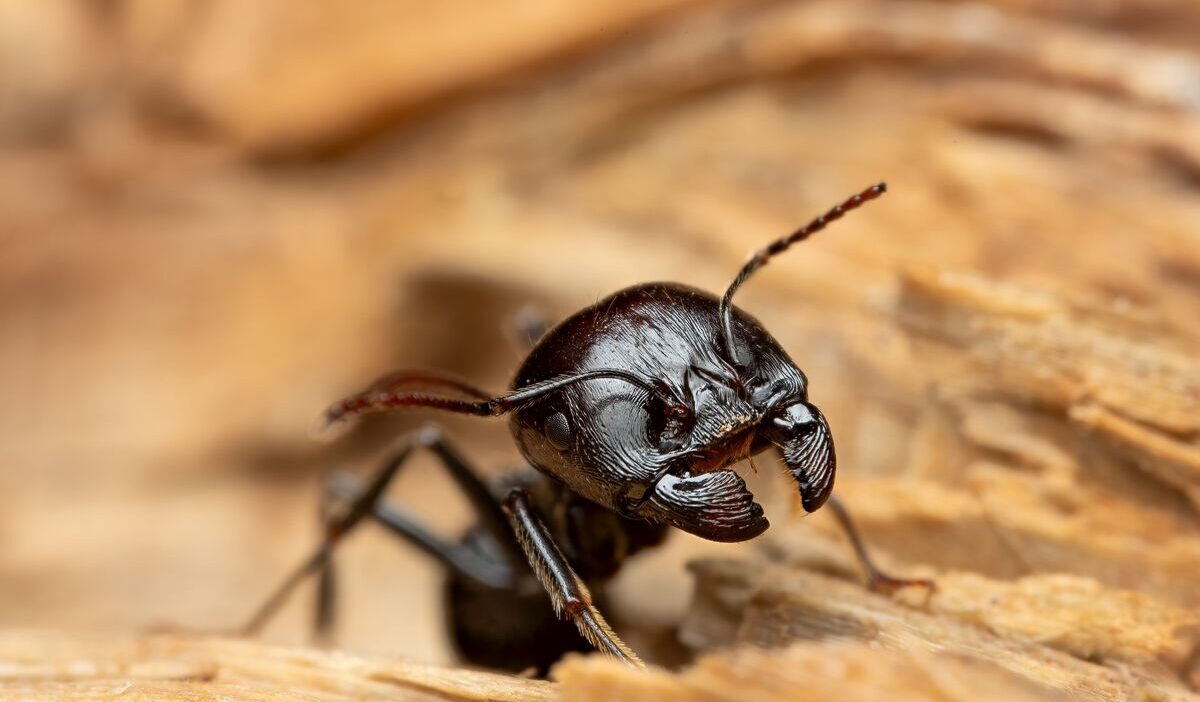
Carpenter ants do not eat wood like termites. Instead, they excavate smooth galleries inside wood to create nesting space. Damage usually develops slowly, but a long-established colony can weaken structural materials, especially when moisture-damaged wood allows the nest to expand.
How to get rid of carpenter ants? Locate the nest, target the colony, and correct the moisture problem that made the area suitable. Killing visible workers may reduce activity temporarily, but it rarely reaches ants hidden inside walls, ceilings, hollow doors, insulation, or subfloors.
Why Do I Suddenly Have Carpenter Ants in My House?
Some workers may be entering from an outdoor colony while searching for food or water. Regular indoor activity, particularly during colder months, may indicate that a parent or satellite nest is located inside the building.
Carpenter ants often establish nests in damp, softened, or decaying wood. They may also use relatively dry spaces such as hollow doors, wall voids, attic insulation, and curtain rods.
Branches touching the roof, firewood stored near the foundation, tree stumps, landscape timbers, and gaps around utility lines can give ants easier access to the house.
Winged carpenter ants emerging indoors are a stronger warning sign than a few workers near a window because swarmers can indicate a mature colony nearby.
How Can You Find a Carpenter Ant Nest?
Locating the nest is usually the most important and difficult part of carpenter ant control. Start by observing active workers in the evening or at night, when their foraging trails may be easier to follow.
Track ants in both directions. One direction may lead to food, while the other may reveal an opening in a wall, cabinet, roof edge, window frame, or exterior structure.
Inspect areas with moisture or damaged wood, including:
- Beneath sinks and around plumbing
- Around tubs, showers, and dishwashers
- Damp window and door frames
- Roof leaks, soffits, and attic beams
- Wall voids and hollow doors
- Crawl spaces and subfloor insulation
- Tree stumps, roots, fence posts, and firewood
- Branches touching the building
>>> Read more: How to Get Rid of Silverfish by Targeting Moisture and Hiding Spots
How to Get Rid of Carpenter Ants
Begin by cleaning sweet spills, grease, pet food, and other food sources. Repair leaking pipes and roof damage, replace decayed wood, trim branches away from the building, and move firewood farther from exterior walls.
What will keep carpenter ants away? The most dependable measures are dry wood, repaired leaks, sealed food, trimmed vegetation, fewer outdoor nesting materials, and closed entry points.
Household scents such as cinnamon, peppermint, lavender, or citrus are not dependable colony-control methods.
Which Carpenter Ant Control Methods Work Best?
The most suitable method depends on whether the nest has been located. Bait is useful for hidden colonies, while direct treatment is generally faster when the nest can be safely accessed.
Ant Baits
Ant bait combines attractive food with a slow-acting insecticide. Workers must feed on it, return to the nest, and share it with other ants. If enough bait reaches the colony, the nest may eventually be eliminated.
Results are gradual. University of Minnesota Extension notes that carpenter ant bait can take weeks or even months to achieve control because success depends on placement, monitoring, and continued bait acceptance.
Direct Nest Treatment
What is the fastest way to kill carpenter ants? When the nest has been accurately located and safely exposed, direct treatment is usually faster than waiting for bait transfer.
A product labeled for carpenter ants and the specific treatment location may be applied directly to an exposed colony. The more of the colony that can be reached, the greater the chance of successful elimination.
Wall voids, ceilings, electrical areas, roofs, and structural supports should generally be handled by a pest professional. Spraying only visible workers will not eliminate the hidden nest because only a small portion of the colony is outside foraging at one time.
Moisture and Wood Repair
Pesticide treatment alone will not correct the conditions that supported the colony.
Replace decayed or severely damaged wood, repair plumbing and roof leaks, improve ventilation, and elevate stored lumber so air can circulate. Keep firewood away from the building and remove nearby stumps or roots when they are supporting an outdoor parent nest.
>>> Read more: Moles Tearing Up the Lawn? How to Get Rid of Moles and Protect Your Yard
How Can You Tell Carpenter Ants From Termites?
Correct identification matters because carpenter ants and termites require different control methods.
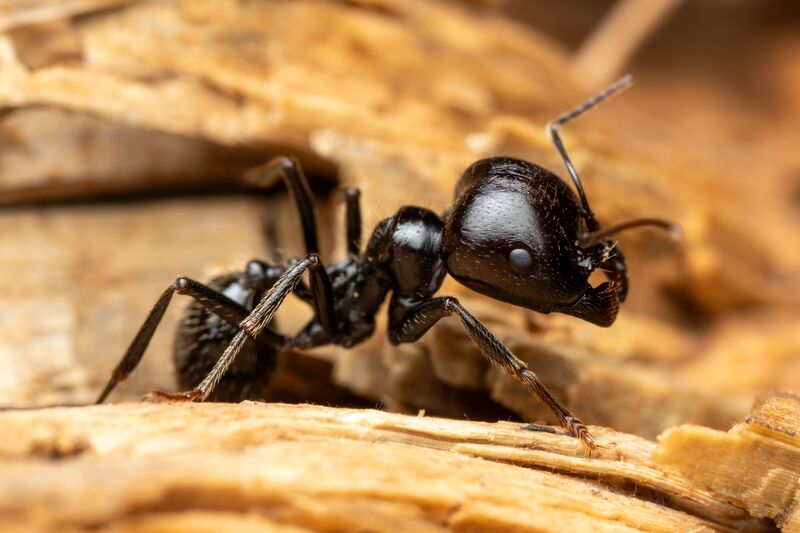
Carpenter ants have a narrow waist, elbowed antennae, and front wings that are longer than their rear wings. Termites have a broader waist, straighter antennae, and two pairs of wings that are approximately equal in length.
Their wood galleries also look different. Carpenter ant galleries are clean and smooth because the ants remove excavated wood. Subterranean termite galleries may contain soil-like material, and termites may build mud tubes along foundations or structural surfaces.
FAQs
Do Carpenter Ants Bite People?
Carpenter ants can bite when handled or when their nest is disturbed, but they do not normally seek out people. Larger workers may produce a painful pinch and can apply formic acid to the area, causing temporary burning or irritation.
Are Carpenter Ants Active at Night?
Yes. Carpenter ants commonly forage during evening and nighttime hours. Watching trails after dark can make it easier to determine where ants enter the building or return toward a nest.
How Long Does It Take for Carpenter Ant Bait to Work?
There is no fixed timeline. General ant bait effects may begin appearing within one or two weeks, but carpenter ant colonies can require several weeks or months to eliminate because bait acceptance and colony structure vary.
Final Thoughts
The central principle of how to get rid of carpenter ants is locating and targeting the colony rather than repeatedly killing visible workers. Follow nighttime trails, inspect moisture-damaged wood, and look for coarse debris beneath possible nest openings.
Bait may reach a hidden colony, while direct nest treatment is generally faster when the nest is accurately located. In every case, repair leaks, replace damaged wood, trim vegetation, and close entry routes.